Is the 'Can-Do-Anything' Engineer Really About Asking Questions? A Hypothesis on Depth, Breadth, and Blank Spaces
This article was generated by AI. The accuracy of the content is not guaranteed, and we accept no responsibility for any damages resulting from use of this article. By continuing to read, you agree to the Terms of Use.
- Intended readers: Mid-career engineers who want to become “full-stack” or “can-do-anything” generalists—or who want to understand what that actually means. People trying to figure out the right order for broadening their skills and what value looks like in the AI era.
- Prerequisites: A basic sense of I-shaped, T-shaped, and Pi-shaped skill profiles (depth vs. breadth) helps, but is not required.
- Reading time: about 12 min
Overview
“You can ask them anything and they’ll figure it out”—every team has one. Someone who somehow gets things done even when the problem is way outside their official specialty. But they’re not “all-knowing.” What they’re actually doing is asking the right questions, then filling the gaps.
Here’s the view this article proposes—and it is a hypothesis: when you have a deep axis (I-shaped) and then add genuine breadth with some thickness (T-shaped, Pi-shaped), you develop the ability to form good questions in the “blank spaces” between specialties. Once the question is formed, you can research it—these days, with AI too—and fill the gap. That chain, viewed from the outside, looks like “the generalist who can do anything.”
This view is not motivational talk. The individual pieces rest on established theory: “absorptive capacity,” which says that breadth of existing knowledge speeds up absorption of new domains; “structural holes,” which says that people who bridge gaps between domains capture better ideas; “recombinant innovation,” which says that broad combinations of knowledge generate novelty; and “problem finding” research, which says that the ability to pose questions—not just solve them—predicts originality and long-term success.
One honest caveat up front, though. Those theories each support one piece. The full chain—”axis + thickness → question-asking power → filling blank spaces → the true identity of the generalist → well-being”—is this article’s own hypothesis. No single study has tested that chain end-to-end, and no study has directly examined “question-asking power is the real secret of generalists” as a proposition. Keep that in mind as you read.
In the AI era, this picture becomes even more relevant. AI mass-produces answers. Forming good questions is still a human job. As AI slashes the cost of “look it up and fill the gap,” people who can form good questions with axis + breadth can fill blank spaces faster than ever before. The caveat: shallow breadth without a deep axis produces neither good questions nor the ability to verify AI’s answers.
Finally, the blank-space style of working connects directly to well-being. Filling gaps that no one else has filled is contribution; crossing domains is variety; posing your own questions and moving on them is autonomy; getting better at things you couldn’t do before is achievement. This article walks through: (1) what the “can-do-anything” person actually is, (2) the mechanisms behind why axis + thick breadth works, (3) why this is scarce in the AI era, and (4) how it connects to well-being.
Part 1: The “Can-Do-Anything” Person Doesn’t Know Everything
flowchart TB
    A["Deep axis (I-shaped)"] --> B["Add breadth with thickness<br>→ T-shaped / Pi-shaped"]
    B --> C["Can form good questions<br>in blank spaces"]
    C --> D["Research and fill the gap<br>(using AI too)"]
    D --> E["The 'can-do-anything'<br>generalist / full-stack engineer"]
    E --> F["Contribution, Variety, Autonomy, Achievement<br>(well-being at work)"]
“Just ask them, they’ll sort it out.” But watch carefully and you’ll see they don’t start with the answer. Even in unfamiliar territory, they identify the right question, make a hypothesis, look it up, and connect the pieces. Faced with an obstacle outside their specialty, they can decompose it: “This part is probably the problem; here’s how I’d split it up.”
By contrast, people who have crammed in a lot of knowledge but don’t know “what to ask” grind to a halt at the edge of the blank space. The difference isn’t the quantity of knowledge—it’s the power to form questions.
And the power to form questions isn’t innate talent. It emerges from the structure of axis and breadth. Let’s look at how.
Part 2: Why Does “Axis + Thick Breadth” Let You Fill the Gaps?
First, let’s be precise about what “breadth” means here. Merely wide and shallow—collecting “I’ve heard of that” familiarity across many fields—doesn’t generate questions. The key is building some vertical thickness at each point in your breadth: enough to know what matters in that domain, where things go wrong, what the catch is. Once that happens, you can see “here’s the blank space” and “here’s what to ask” across a much wider range, and the range of questions you can form expands dramatically. That range is determined not by how wide your breadth is, but by breadth × thickness at each point—volume, not area. The horizontal bar of the T works better as a thick plank than a thin line.
In practice, you can’t build uniform thickness everywhere—time doesn’t allow it. The realistic approach is “one deep axis (vertical) + islands of thickness at key points.” Think less “uniformly thick plank” and more “scattered dots of thickness where they matter most.”
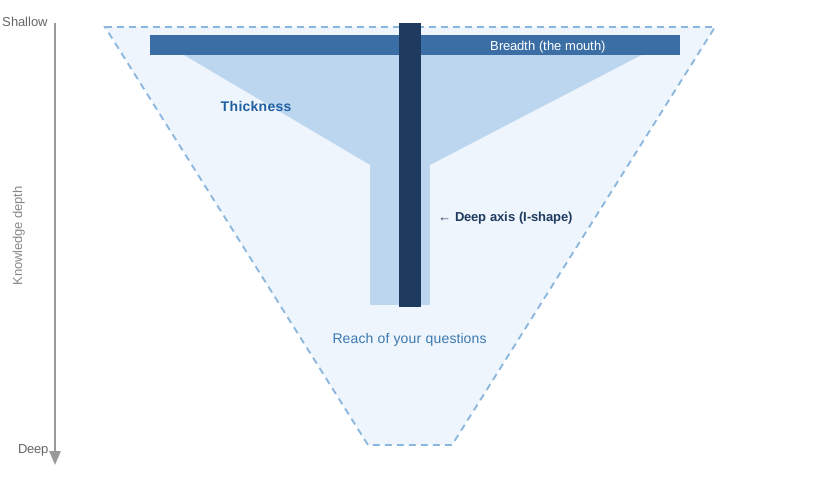
This structure is easiest to grasp as a cross-section of your skills (diagram above). The opening of the funnel is breadth, the narrow tube running down the center is the deep axis (I-shaped), and the light-blue body between them is thickness. Beyond the funnel’s edge—especially below, into deeper territory—your questions can reach even where your concrete knowledge doesn’t (dashed lines). The wider the opening, the more thickness at key points, and the deeper the axis, the further your questions can reach outward and downward. In Pi-shaped profiles, the narrow tube becomes two. And when you have two axes, the space between them becomes its own new blank space—more possible combinations, more directions to form questions (this too is an extension of the same hypothesis). Note: this diagram is a conceptual illustration of the hypothesis, not an empirical data visualization.
Four mechanisms explain why “thick breadth” generates questions.
(1) Absorptive Capacity—the broader your knowledge, the faster you absorb new domains. Cohen & Levinthal’s “absorptive capacity” theory shows that the ability to understand, absorb, and apply new knowledge depends on the breadth of related knowledge you already hold.1 Information from a totally unfamiliar domain passes right through you, however valuable it is. But even a little background in an adjacent area activates the “look it up and make it work” circuit. The thickness of your horizontal bar is the diameter of that circuit. And this effect grows as information access improves—a meta-analysis of 145 studies found that, in the post-smartphone information environment, the effect of absorptive capacity on innovation nearly doubled compared to before.2 The more information-rich the era, the more valuable your ability to absorb it. (This is an organizational-level finding, but the same logic applies to individuals.)
(2) Structural Holes—the bridge-builder between groups monopolizes good questions. Burt’s “structural holes” research shows that people who bridge the gaps between different groups or knowledge domains capture informational advantages and the source of good ideas. In a study of 673 managers, people with cross-domain networks generated ideas rated more highly—and less likely to be rejected—by independent evaluators.3 The reason is simple: the “gap visible from both sides” is invisible to people locked inside a single domain. Only someone with knowledge of both sides can form a question about the space between them.
(3) Recombination—combinations of broad knowledge generate novelty. Innovation is, in most cases, a new combination of existing knowledge—though novel combinations on average come with high variance, and the breakthroughs emerge from the tail of that distribution.4 An analysis of 17.9 million papers found that the highest-impact work balanced “conventional foundations + atypical combinations”; this type was twice as likely to reach the top 10% of citations.5 A deep axis (conventional foundation) plus broad knowledge increases the number of combinations available, allowing you to bring new connections into the blank space.
(4) Technology Brokering—what the horizontal bar of the T actually looks like in practice. Research on the design firm IDEO makes this concrete. IDEO accumulated knowledge across more than 40 industries and systematically transferred known solutions from one industry to unsolved problems in another.6 This is the “technology broker”—the T’s horizontal bar functioning in the real world. Worth noting: direct quantitative studies of T-shaped and Pi-shaped profiles are limited; this piece leans on qualitative research.
All four share the same underlying structure: breadth works less for the knowledge itself and more for forming questions and making connections. The horizontal bar isn’t a collection of trivia. It’s a device for finding blank spaces, forming questions, and bringing in solutions from other domains.
Part 3: The AI Era—Question-Asking Power Becomes Scarce
“Solving” and “question-asking” are different capabilities. In a landmark longitudinal study, Getzels and Csikszentmihalyi found that art students who spent more time exploring before starting to draw—”problem finders”—produced work rated more original by independent judges. Follow-up studies after graduation showed that problem finders achieved greater professional success. IQ and academic grades, by contrast, were uncorrelated with success.7 The ability to form good questions is independent of solving ability or test performance, and it compounds over time.
This distinction becomes decisive in the AI era. AI mass-produces answers. But what to ask is still decided by humans. As AI slashes the cost of “research and fill the gap,” people who can form good questions with axis + breadth can fill blank spaces faster than before. The four mechanisms from Part 2 get amplified by AI as an accelerant.
Two caveats, though. First, shallow breadth without a deep axis doesn’t generate good questions in the first place—absorptive capacity is low and you can’t even see where the blank spaces are. Second, AI’s answers include “close but wrong.” Catching that requires a deep axis capable of verification. AI can help you form questions, but outsourcing the question itself to AI returns average, generic questions—and atrophies your own ability to ask. One researcher argues both sides of this simultaneously.8 So the order still holds: deep axis first, then breadth on top of it.
In practice, AI adoption is already shifting how engineers spend their time—from writing code to verifying and orchestrating AI output.9 This shift pushes in exactly the direction of raising the value of “forming questions, identifying blank spaces, and connecting pieces.”
Part 4: The Connection to Well-Being (Seven Factors)
The blank-space style of working connects directly to well-being at work. Delivering value that no one else is delivering is contribution; crossing domains is variety; posing your own questions and moving on them is autonomy; getting better at things you couldn’t do before is achievement. The generalist who can do anything doesn’t look energized by accident—this mode of working simultaneously satisfies several of the seven factors that determine well-being at work. (The evidence behind those seven factors is covered in detail in Good Work Isn’t Chosen—It’s Crafted.)
One honest caveat here too: broadening your skills isn’t inherently good for well-being. Breadth improves well-being only when it generates contribution, autonomy, and achievement through question-asking power. The standalone evidence for “variety” as a factor is, frankly, only moderate. And not everyone should aim for Pi-shaped—there’s a path of deep contribution and achievement that comes from drilling one axis deeply. Pi-shaped is one form that works for people who find joy in filling blank spaces. It’s not the universal answer.
As a Hypothesis—How Far Is It Solid?
Let’s be clear about what the evidence actually supports. The individual mechanisms at the core of this article are backed by established research: that breadth speeds absorption of new domains (absorptive capacity); that people bridging domain gaps capture better ideas (structural holes); that broad combinations of knowledge generate novelty (recombination). Those pieces are solid.
But connecting them into a single chain is a hypothesis, not an established fact. No study has tested “axis + thickness → question-asking power → filling blank spaces → the true identity of the generalist → well-being” end-to-end. No study has directly examined whether “question-asking power is the real secret of generalists” as a proposition. The “skill funnel” and “reach of questions” are metaphors for explanation, not empirical constructs. The claim that “questions become scarce in the AI era” currently exists at the level of reasoned argument, not empirical finding.
Even so, each individual piece is solid enough that the hypothesis is worth taking seriously. Don’t accept it as established fact—instead, check it against your own experience and see whether it fits.
Summary
The “can-do-anything” person doesn’t know everything. With axis + breadth, they form good questions and fill the blank spaces. Absorptive capacity, structural holes, recombination, problem finding—established theories support this picture.
AI mass-produces answers, but questions are still a human job. So in the AI era, people who can form good questions with axis + breadth become more valuable, not less. But shallow breadth without an axis generates neither good questions nor the ability to verify AI’s output. The order still holds: deep axis first.
And the blank-space style of working connects directly to contribution, variety, autonomy, and achievement—the core of well-being at work. Breadth is not the goal in itself. Breadth generates question-asking power, and that generates well-being. Getting the order right is what matters.
If you want to become someone who “can do anything,” start by digging one thing deeply. Build breadth on top of that axis, then form questions in the blank spaces. That is, this hypothesis suggests, the rarest and most fulfilling way to work in the AI era.
Related Posts
- Good Work Isn’t Chosen—It’s Crafted: The Evidence Behind the Seven Factors of Job Satisfaction — What the “well-being” this article refers to actually consists of
- I-shaped, T-shaped, Pi-shaped: The Depth × Breadth Skill Matrix — A taxonomy of skill “shapes”
- Why the Axis-less Generalist Hits a Ceiling: You Need One Deep Axis Before Going Full-Stack — Why breadth without depth doesn’t compound
- Employee Well-being Can’t Be Bought with Programs: The Organizational Levers That Design the Seven Factors — The organization’s side of designing for well-being
References
Absorptive capacity: A new perspective on learning and innovation — Cohen, W. M., & Levinthal, D. A., Administrative Science Quarterly (1990). [Reliability: High] ↩︎
Absorptive capacity and innovation: A meta-analysis — Stettler, T. R., et al., Journal of Product Innovation Management (2025). [Reliability: Medium-High (meta-analysis, 145 studies)] ↩︎
Structural holes and good ideas — Burt, R. S., American Journal of Sociology (2004). [Reliability: High] ↩︎
Recombinant uncertainty in technological search — Fleming, L., Management Science (2001). [Reliability: High] ↩︎
Atypical combinations and scientific impact — Uzzi, B., Mukherjee, S., Stringer, M., & Jones, B., Science (2013). [Reliability: High (though individual knowledge breadth and team diversity are not disaggregated)] ↩︎
Technology brokering and innovation in a product development firm — Hargadon, A., & Sutton, R. I., Administrative Science Quarterly (1997). [Reliability: Medium-High (qualitative ethnography)] ↩︎
The Creative Vision: A Longitudinal Study of Problem Finding in Art — Getzels, J. W., & Csikszentmihalyi, M., Wiley (1976) (book). [Reliability: Medium-High (arts domain, small-sample longitudinal study)] ↩︎
AI can help you ask better questions — and solve bigger problems — Gregersen, H., Harvard Business Review (2023). [Reliability: Medium (practitioner argument)] ↩︎
DORA 2025: State of AI-Assisted Software Development — Google Cloud / DORA (2025). [Reliability: High] ↩︎